 Simple Household Budget
Fixed expenses list: what counts, and what's left?
Fixed expenses are costs that leave your account regularly at a set amount – rent, utilities, insurance, contracts, subscriptions. Subtract their total from your take-home pay and you know how much you have for everything else. The checklist below helps you not to miss any.
Updated: November 2026
Fixed or variable?
A simple test: would the amount still go out if you did nothing at all this month? Then it's a fixed cost. Rent, your phone contract and insurance keep running whether you go out or not. Groceries, eating out, clothes and fuel depend on what you do – those are variable costs.
Put your savings on the list too. Treat them like a fixed bill and you save before the money is spent.
Checklist: monthly fixed expenses
| Area | Typical items |
|---|---|
| Home | Rent or mortgage, service charges, heating, electricity, water (often included in service charges for tenants) |
| Communication | Internet, landline, mobile phone, TV licence where applicable |
| Getting around | Public transport pass, car loan or lease |
| Insurance | Health insurance (if not deducted from pay), supplementary health cover, income protection, others |
| Savings | Savings account, index fund plan |
| Subscriptions and memberships | Music and video streaming, gym, newspaper, software and AI subscriptions, music lessons, clubs |
Checklist: yearly and quarterly expenses
These are the ones most often forgotten, because they come so rarely:
- Liability, contents and legal expenses insurance
- Car insurance, vehicle tax, breakdown cover
- Annual credit card or bank card fee
- Club fees charged once a year
- Annual subscriptions (streaming, delivery memberships, domain, software)
How to plan for them so a month doesn't suddenly run dry: yearly bills in a monthly budget.
Where to find the amounts
- Go through three months of bank statements: standing orders and direct debits that show up every month are your monthly fixed costs.
- Search the last twelve months for amounts that appear only once or four times – those are the yearly and quarterly ones.
- Check contracts and notices: insurance policies, tax notices and your tenancy agreement state the amount and the due date.
What's left after fixed costs
| Take-home pay | €2,100.00 |
|---|---|
| − Rent and service charges | €780.00 |
| − Electricity, internet, phone | €105.00 |
| − Insurance | €65.00 |
| − Subscriptions and club | €40.00 |
| − Transport pass | €58.00 |
| − Savings | €100.00 |
| Left to spend | €952.00 |
This is the most important number in your budget. Divide it by the days in the month and you have your daily budget.
If fixed costs leave hardly anything, look at subscriptions and contracts first – they're the easiest to cancel or switch.
With the app
Enter fixed costs once, then forget them
Setup in Simple Household Budget walks you through a list like this: item by item – rent, heating, electricity, service charges, internet and so on – you type the amount or leave it empty if it doesn't apply. The plus button adds more, with suggestions such as streaming, gym or car insurance.
Yearly items get a due date. From then on the app deducts your fixed costs every month by itself, and the home screen only shows what you really have left.
Get it on Google Play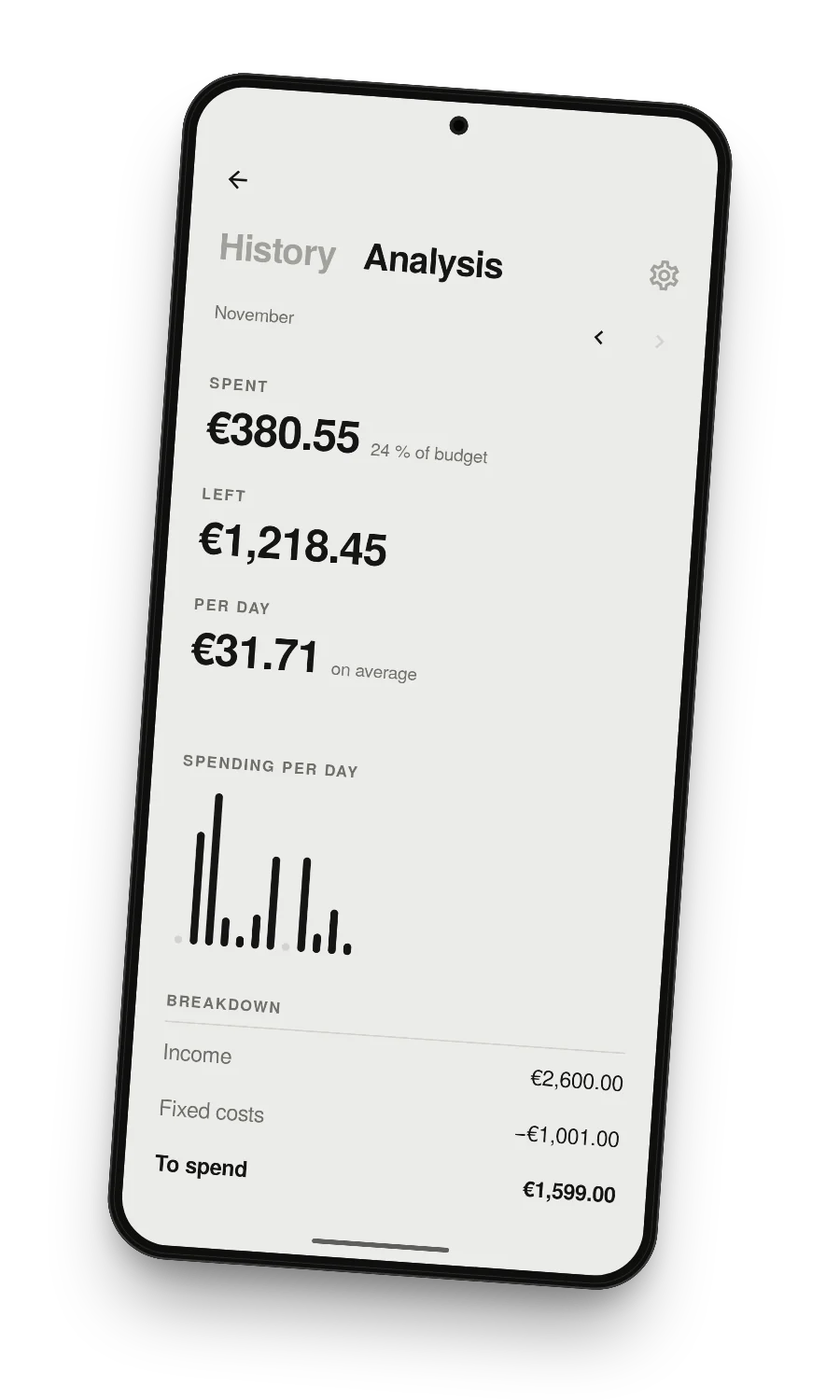
Questions
Are savings a fixed expense?
In your budget: yes. Take them off at the start of the month like a fixed bill and you save reliably. Anything extra left at the end is a bonus.
Are groceries a fixed expense?
No, even though they come up every month. The amount varies and depends on you, so they're a variable expense.
What share of income should fixed costs be?
There's no fixed limit. What matters is that enough is left for food, everyday life and the unexpected. Work it out with your own numbers – the table above shows how.
What about costs that change slightly, like electricity?
Use your current monthly payment. If it changes, update the amount. What counts in a budget is that the item is there at all.