 Simple Household Budget
No-spend challenge: rules, variations, results
In a no-spend challenge you don't spend money on non-essentials for a set time. Fixed costs keep running, and groceries from a list are usually allowed. What makes it work: rules you write down beforehand – and a number at the end that shows what it achieved.
Updated: November 2026
Three variations
| Variation | For whom | Typical goal |
|---|---|---|
| No-spend days | beginners | e.g. 10 days a month with no spending at all |
| No-spend week | after an expensive month | one week of groceries from a list only |
| No-spend month | experienced budgeters | a month without clothes, eating out or online shopping |
No-spend days are the easiest start. A full month without exceptions often fails at the first birthday invitation.
Write the rules down first
- What keeps running: rent, utilities, insurance, subscriptions – everything that goes out automatically.
- What's allowed: groceries from a list? Fuel for the commute? Medicine?
- What's not allowed: eating out, delivery, clothes, online shopping, takeaway coffee.
- What happens with exceptions: a gift for a party isn't failure if the rules allow it.
Without written rules every exception becomes a negotiation with yourself – and you usually lose.
Measure the result
Compare spending without fixed costs to a normal month:
| Spending last month | €860.00 |
|---|---|
| Spending in the no-spend month | €610.00 |
| Difference | €250.00 |
Set the difference aside straight away – to savings or your emergency fund. Otherwise it vanishes next month.
What a no-spend day is worth
| Spending last month | €860.00 |
|---|---|
| ÷ 30 days | €28.67 |
| × 10 no-spend days | about €287 |
That only holds if the spending isn't simply moved to the next day. Ten no-spend days followed by a big weekend shop save nothing.
After the challenge
The value is less in the money saved than in what you noticed: what did you really miss, and what not at all? What you didn't miss can go for good. What you did miss can come back into the budget – on purpose.
With the app
See no-spend days in Simple Household Budget
The analysis shows a chart by day. Days without spending show only a small pale dot instead of a bar – so you see your no-spend days at a glance, without a separate tally. Use the arrows in the analysis to compare Spent with the previous period.
The bar on the home screen shows how much of the month's money is spent and how far along the month is. In a no-spend month the fill stays well behind the mark.
Get it on Google Play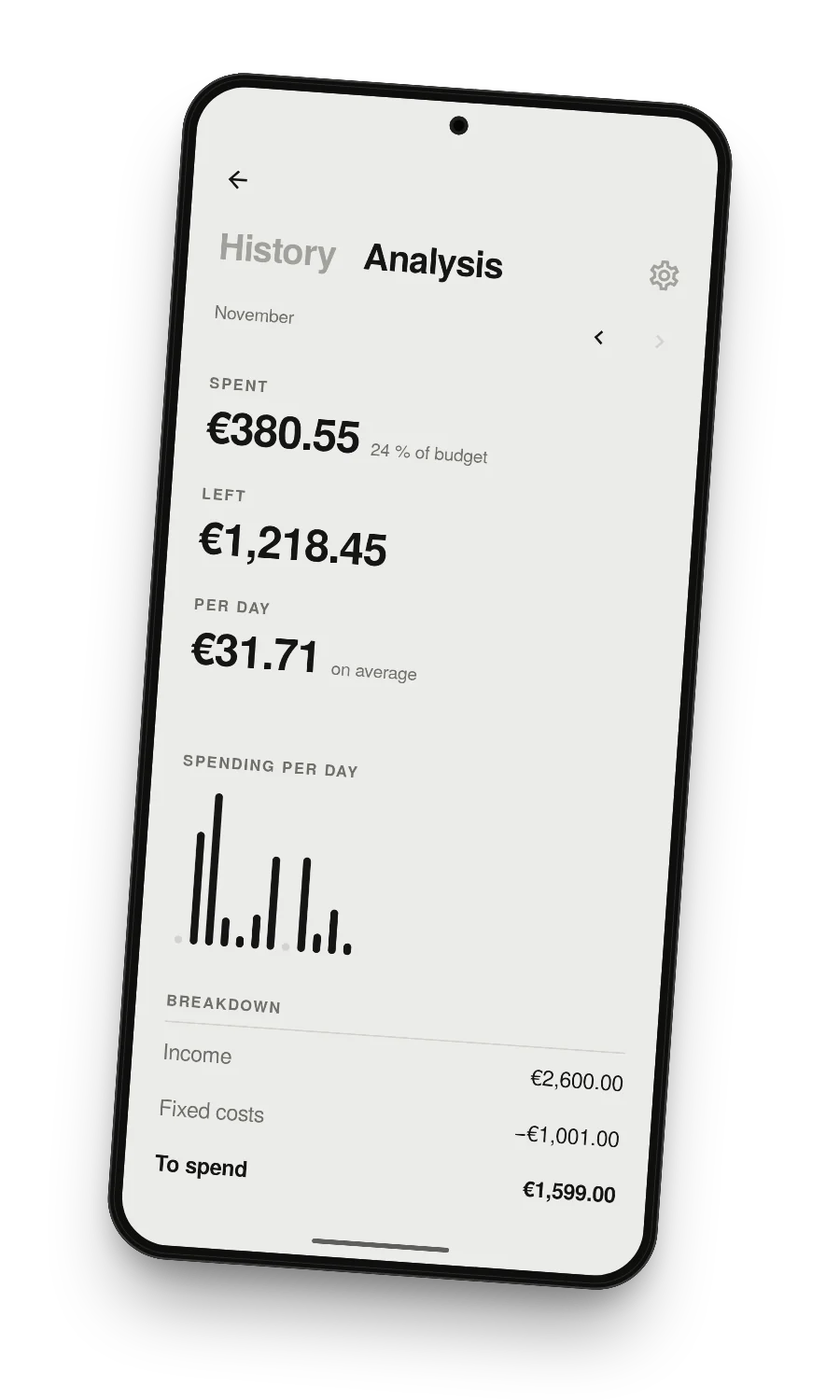
Questions
Do groceries count as spending?
You decide. Most people allow groceries from a list and rule out impulse buys and eating out.
What if I break the challenge?
Write down why and carry on. One exception doesn't end the challenge – it shows you where a rule was too strict or too vague.
How often should you do a no-spend challenge?
Hardly anyone keeps it up permanently. One no-spend month a year or a few fixed no-spend days each month work better for many people.