 Simple Household Budget
Emergency fund: how much, how to build it, where to keep it
A common rule of thumb: three to six months of essential expenses. Add up your fixed costs plus the bare essentials for daily life – with €1,150 fixed costs and €450 essentials that's €1,600 a month, so €4,800 to €9,600. Keep the money separate from your everyday account but available at any time, for example in an savings account you can withdraw from at any time.
Updated: November 2026
What the emergency fund is for
An emergency fund isn't holiday money or savings for the insurance bill in March. It's for what you can't plan: a broken washing machine, a car repair, losing your job, an unexpected bill. Without it, such things end up on an overdraft or a credit card – and that costs interest.
Plannable costs such as yearly insurance belong in a separate pot: yearly bills in a monthly budget.
The size, from your own numbers
- Add up your fixed costs – rent, utilities, insurance, contracts. The fixed expenses list helps.
- Add the essentials: groceries, toiletries, getting around. Not what you spend now, but what you'd need in an emergency.
- Multiply by three to six. The less secure your income, the closer to six.
| Fixed costs per month | €1,150.00 |
|---|---|
| + Essentials | €450.00 |
| = Monthly need | €1,600.00 |
| × 3 months | €4,800.00 |
| × 6 months | €9,600.00 |
If you're self-employed, have children or live on one income, aim for the upper end. In a secure job with two incomes, the lower end is often enough.
Build it in stages
A target of €4,800 can feel out of reach on a small budget. Break it up:
| Stage | Amount | at €100 a month | at €200 a month |
|---|---|---|---|
| Starter fund | €1,000 | 10 months | 5 months |
| One month's need | €1,600 | 16 months | 8 months |
| Three months' need | €4,800 | 48 months | 24 months |
One-off money gets you there faster: a tax refund, a bonus, what's left at month end. If you consistently move leftovers into the fund, you'll usually get there a lot sooner.
Where to keep it
- Separate from your everyday account, so it doesn't look like spending money.
- Available at any time, with no notice period and no market risk – for example an savings account you can withdraw from at any time.
- Not in stocks or investment funds. Emergencies don't wait for good markets.
With the app
Read your monthly need from Simple Household Budget
The analysis shows under Breakdown how much income and fixed costs are. Fixed costs are the biggest part of your monthly need – leave out any savings item, it isn't a need. For the essentials, take the Per day figure from the analysis × 30 as an upper limit and trim it to what you'd really need.
Add your monthly emergency-fund saving as a fixed item; if you add it later, it counts from the next period.
Get it on Google Play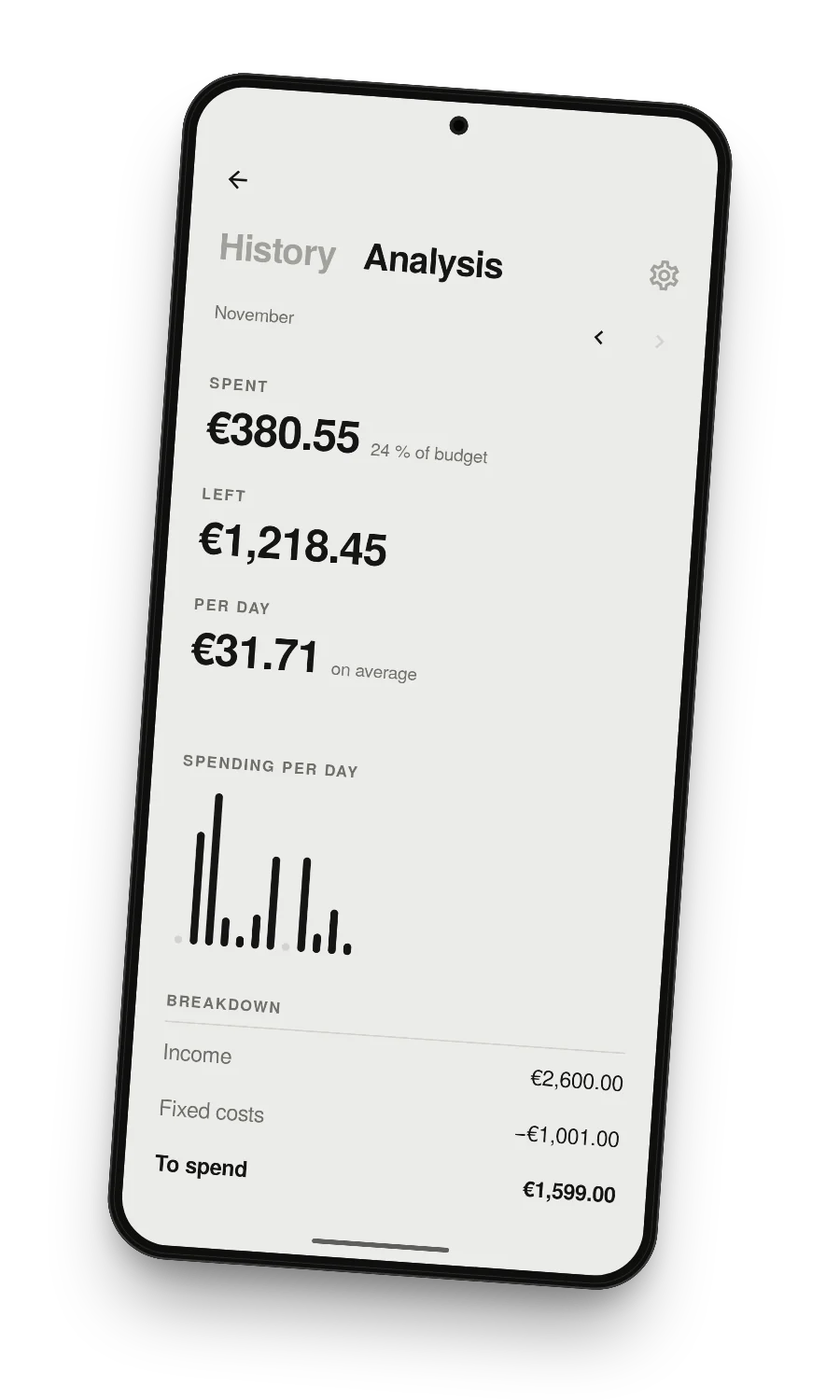
Questions
Does an overdraft count as an emergency fund?
No. An overdraft is an expensive loan. The emergency fund is there so you don't need it.
Should I pay off debt or build the fund first?
A small fund of around €1,000 usually comes first – otherwise the next repair creates new debt. After that, it pays to clear expensive debt such as overdrafts or credit cards faster.
What if I've had to use it?
Top it back up before saving for anything else. Keep your usual savings amount running until it's full.